Demand & Channels
Global market overview and supply context.
Market Overview
Executive Summary
- ■ Concentrated global supply, led by Colombia and Zambia, with additional established supply from Brazil, Zimbabwe and other smaller sources.
- ■ A two-tier market: commercial-quality supply can be relatively abundant, while fine and exceptional material remains scarce, with materially different pricing dynamics across quality categories.
- ■ Demand for coloured gemstones remains resilient, but buyers are increasingly selective, with competition concentrated in rare, fine and distinctive material; Chinese and Hong Kong buyers have shown greater caution in 2026.
- ■ Emerald is not a standardised commodity: value is driven by colour, clarity, size, treatment, origin and certification, so quality mix, not volume alone, determines value.
- ■ Consistent grading, transparent treatment disclosure, certification and traceability are increasingly important to buyers.
Global Production Reference
| Country | Mine Reference | % Fine Quality |
|---|---|---|
| Brazil | Piteiras, Capoeirina, Belmont | 10% |
| Central Asia | Swat Valley, Panjshir Valley | 17% |
| Colombia | Muzo, Coscuez | 30% |
| Ethiopia | Shakiso | 10% |
| Madagascar | Mananjary | 10% |
| Russia | Malysheva | 0.25% |
| Zimbabwe | Sandawana | 10% |
| Zambia | Kagem | 10% |
Source: Indicative industry estimates compiled from publicly available gemstone market studies and trade references.
Market Size & Growth
Upstream
The upstream rough emerald market is estimated to be valued between several hundred million and low billions of USD annually, with strong year-to-year volatility. Supply remains concentrated in a handful of producing countries, making the market sensitive to mine output, auctions, and geopolitical factors.
Retail
The global retail emerald market is estimated to be in the multiple billions of USD, driven by brand, design, and craftsmanship premiums. High-end jewellery houses capture most of the value chain, with luxury positioning transforming emeralds into both a fashion and investment product.
Data Source
Indicative market size estimates compiled from publicly available industry commentary and secondary sources, including publications and auction disclosures by Gemfields Limited, reports and market insights from GIA and Gübelin Gem Lab, and broader coloured gemstone market studies. Figures are approximate only.
Global Market
Demand & Channels
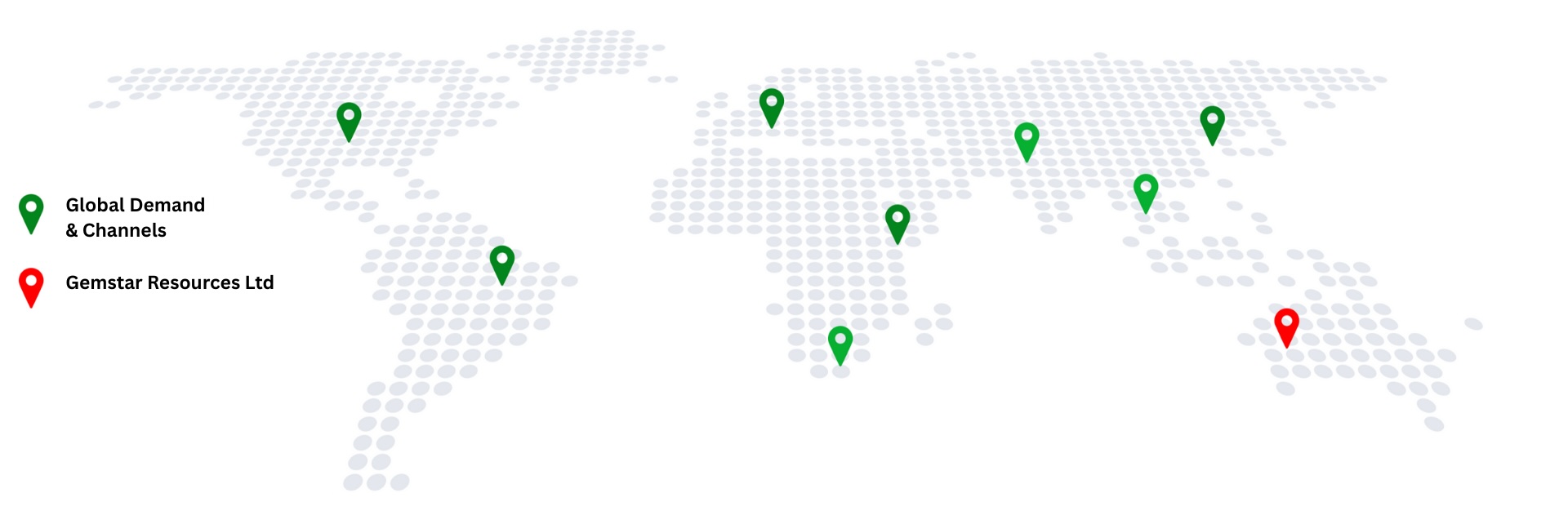
US / EU
Maisons and auction houses dominate top-end trade.
China
Rapid adoption of colored gemstones; focus on certificates & branding.
India / Middle East
Deep jewelry culture & cutting hubs (Jaipur).
Global Hubs
Hong Kong, Singapore, Dubai (trading & re-export).